
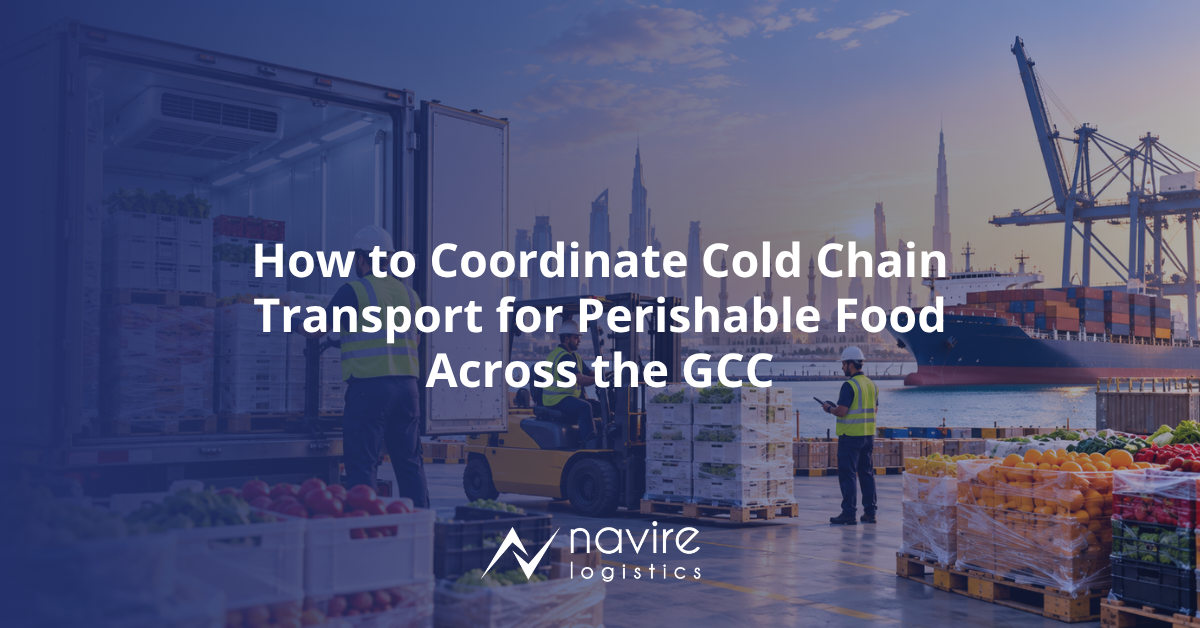
What happens to a truck of chilled yogurt when it sits at a border for six hours in summer heat? And what if the reason it is sitting there is one missing document? If you ship perishable food across the GCC, the answers decide whether your load arrives sellable or gets rejected. Temperature limits, country-by-country food approvals, border waiting times, split responsibility and gaps iHow to Coordinate Cold Chain Transport for Perishable Food Across the GCCn insurance cover are the problems behind most cold chain losses. Navire Logistics helps shippers handle all of them as one job. This blog examines the five problems that cause most perishable food losses across the GCC and shows how Navire Logistics helps you avoid them.
Cross-border cold chain shipping means moving temperature-sensitive food such as dairy, meat, poultry and fish between GCC countries without breaking the required temperature at any point. The GCC is a customs union, so duty is paid once at the first point of entry. Even so,perishable shipment is judged on its temperature, its paperwork, how long it waits, who is responsible for it and whether it is properly insured. A weakness in any one of these can ruin the whole load.
Mixed temperatures in one load
Saudi food transport guidance sets frozen food at −18°C or colder, chilled meat, poultry and dairy at 5°C or below, and fresh fish at 0°C. Products with different limits cannot share one setpoint, so a mixed load planned as a single unit will always leave some products at the wrong temperature. The safest approach is to list the carriage temperature for every product before booking, group products by temperature, pre-cool the unit and probe the product at loading. Navire runs a temperature-controlled warehouse in Dubai with cross-docking and trans-loading, so a mixed consignment can be split into the right temperature groups before it travels and loaded into temperature-controlled packaging with monitoring.
Missing or wrong paperwork
Food approvals are still handled country by country, even though the GCC is a customs union. A truck leaving Abu Dhabi for Saudi Arabia also needs a customs declaration, Fasah details and a Truck Crossing Permit. If any one of these is missing, the truck waits and the cargo warms up. Shippers should register the product and label before ordering, assemble the health, halal and customs documents early, and file the declaration and permits before the truck reaches the border. Navire’s Dubai Municipality registration service guides you through documents, application, fees and certificate, while its customs clearance team prepares documentation, calculates duties and taxes, and arranges required inspections, including for free-zone cargo.
Waiting at the Border
Even with good paperwork, border delays happen. The real risk is a warm load with no one watching it. A well-planned shipment assumes the wait will happen, so it uses a vehicle with a temperature recorder and enough fuel for waiting as well as driving. Alarm thresholds should be set slightly inside the product limit, and the plan for a long hold should be decided in advance. Navire’s door-to-door service includes cargo tracking at every stage and 24/7 customer support, so someone is watching the shipment while it waits. Its transport team also selects carriers with validated processes for temperature-sensitive goods.
Too Many Handovers
The forwarder, the clearing agent, the trucker and the cold store each own one piece of the journey, but nobody owns the whole thing. Problems fall between the handovers, and the shipper is left chasing several companies for one answer. The fix is to appoint one party accountable from pickup to delivery and keep a single record of temperatures, documents and handovers. Navire’s door-to-door cargo service covers pickup, customs clearance, documentation, delivery and tracking under one provider. It works from Dubai, with a Saudi arm in Jeddah, so both ends of the main UAE-Saudi route are covered.
Insurance Cover That Does Not Match the Risk
Some cargo policies exclude refrigeration failure or delay, which are the most likely losses in a cold chain. Many shippers only find this out when they file a claim. Read the policy wording before you ship and make sure it matches your actual route and cargo. Navire’s in-house marine cargo group arranges cover for goods moving by sea, air, truck or rail, either per shipment or as an annual policy, and supports claims and recovery.
How to Choose the Right Provider
When you compare providers for GCC perishable shipments, ask one question first: who is accountable if something goes wrong between pickup and delivery? A provider that handles only the truck, or only the paperwork, leaves the gaps to you. Look for one company that plans temperature groups, prepares documents, tracks the shipment at every stage, offers round-the-clock support and arranges suitable cargo insurance. Navire Logistics offers all of these under one door-to-door service, from Dubai and from its Saudi arm in Jeddah.



