
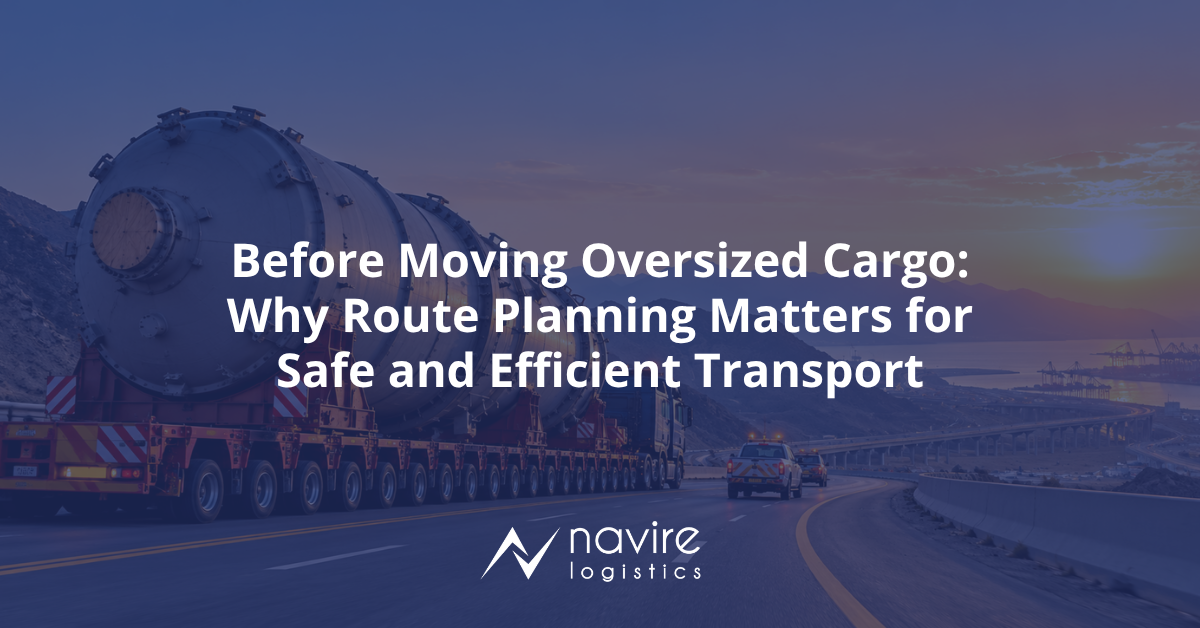
What if the costliest part of moving oversized cargo isn’t the ship, the crane, or the trailer, but a bridge you never checked?
A 45-meter wind turbine blade clears the port on schedule. The convoy is rolling, and the client is happy. Then, 12 kilometers from the project site, the lead escort radios in. The overhead pedestrian bridge ahead is 40 centimeters too low.
The convoy stops. Police are called. Every hour of delay now costs more than a route survey would have. This happens more often than the industry likes to admit. And here’s the truth most shippers learn too late: oversized cargo rarely fails at sea. It fails on the last 50 kilometers of road.
Welcome to the world of oversized cargo route planning, where the move is won or lost before the first wheel turns.
What Makes Oversized Cargo Different?
Cargo becomes “oversized” when its length, width, height, or weight exceeds the legal limits for standard road transport. Think transformers, turbine blades, mining machinery, pressure vessels, and prefabricated industrial modules.
A standard truck follows standard roads without much thought. An oversized load cannot. Every bend, bridge, overhead cable, and roundabout becomes a potential obstacle.
Legal limits vary by emirate and country, so always confirm current thresholds with the relevant authority.
Why Oversized Cargo Route Planning Is the Most Important Step
Think of route planning as the blueprint for the move. Without it, you are not transporting cargo. You are gambling with it.
✔️ Safety First
A load that meets a low bridge, a tight curve, or a weak road surface can injure people and damage public infrastructure. A proper survey finds these hazards on paper, not on the road.
✔️ Cost Control
Idle cranes, waiting crews, extra escort hours, and missed delivery windows add up quickly. Planning removes the surprises that inflate project budgets.
✔️ Schedule Reliability
Heavy-haul moves usually feed into tight project timelines. One delay at the transport stage can push back installation, commissioning, or an entire launch.
✔️ Regulatory Compliance
Most jurisdictions require permits, approved routes, and set travel windows. Moving without them can mean fines, canceled permits, or cargo stopped mid-journey.
What Does a Heavy Haul Route Survey Include?
A route survey is a physical and digital inspection of the entire journey, from pickup to final placement.
| Survey Element | What Is Checked | Why It Matters |
|---|---|---|
| Vertical clearance | Bridges, tunnels, overhead cables | Prevents strikes and forced reroutes |
| Horizontal clearance | Lane width, roundabouts, turning radii | Confirms the load can physically turn |
| Road capacity | Bridge ratings, surface strength | Protects infrastructure and cargo |
| Gradients and curves | Slopes, ramps, sharp bends | Affects axle loading and braking |
| Traffic and works | Peak hours, construction zones | Avoids gridlock and permit violations |
| Utilities | Power lines, street lights, signals | Flags items needing temporary lifting |
| Final site access | Gate width, ground bearing | Prevents last-meter failures |
◾ Pro tip: Many teams survey the main route and overlook the final access road. The last kilometer deserves the same attention as the first hundred.
The Permit and Approval Puzzle
Oversized movements generally need approval from road authorities and, often, police coordination. This can involve:
- Transport permits stating dimensions, weight, and the approved route
- Travel time restrictions, with many moves limited to off-peak or night hours
- Escort requirements, such as police or private pilot vehicles
- Utility coordination, where cables or signals must be lifted or moved temporarily
Permit timelines are often longer than shippers expect. That is why route planning should begin before the cargo is booked on a vessel, not after it reaches the port.
Plan the Whole Journey, Not Just the Road
Oversized cargo is usually a multimodal challenge. The journey may include ocean freight, port handling, heavy-lift cranes, trailers, and final positioning.
✔️ Port Handling: Heavy lifts need available cranes, adequate quayside strength, and storage space reserved well before the vessel arrives.
✔️ Right Equipment: Hydraulic modular trailers, extendable trailers, and multi-axle setups each suit different loads. The right choice spreads weight evenly and improves maneuverability.
✔️ Accurate Documentation: Mismatched dimensions or weights on paperwork can hold up project cargo at the border. Our customs clearance services in Dubai help keep documentation consistent from origin to destination.
Common Route Planning Mistakes to Avoid
Mistake 1: Relying Only on Digital Maps
Navigation tools do not reflect temporary roadworks, new construction, or exact clearance limits. A physical survey catches what satellite images miss.
Mistake 2: Starting Too Late
Permits, escorts, and utility coordination take time. A last-minute plan means last-minute costs.
Mistake 3: Ignoring Seasonal Conditions
Extreme heat can affect road surfaces and equipment performance, and weather can restrict movement. Build conditions into the schedule.
Mistake 4: Skipping a Backup Route
Accidents and closures happen. An approved alternative keeps a minor disruption from becoming a major delay.
Mistake 5: Choosing on Price Alone
The cheapest quote often leaves out survey costs, escorts, and permit handling. Compare the full scope of work, not just the headline number.
A Simple Seven-Step Planning Checklist
Step 1: Gather Accurate Cargo Data.
Confirm exact length, width, height, weight, and center of gravity.
Step 2: Define the Full Route.
Include the port, the site, and every handling point between them.
Step 3: Conduct the Route Survey.
Measure clearances and identify obstacles on the ground.
Step 4: Secure Permits and Escorts.
Apply early and confirm approved travel windows.
Step 5: Select Equipment and Crew.
Match trailers, cranes, and personnel to the load.
Step 6: Assess the Risks.
Identify what could go wrong and prepare a response for each risk.
Step 7: Execute and Monitor.
Keep drivers, escorts, and the control team in constant contact.
Plan the Route Before You Move the Cargo
Oversized cargo transport is a precision exercise. The difference between a smooth delivery and a costly standoff almost always comes down to what happened before the truck started moving.
A thorough route plan protects your people, your cargo, and your project timeline. It turns an uncertain journey into a predictable one.
Why Work With a Specialist?
Oversized cargo is not the place for trial and error. An experienced project logistics partner brings route knowledge, authority relationships, the right equipment, and a team that has solved these problems before.
At Navire Logistics, our project cargo logistics team manages the full journey, from planning and permits to port handling and final delivery. Backed by our transportation services in Dubai and global freight forwarding network, we help clients move heavy and out-of-gauge cargo with confidence.
Planning an oversized or project cargo move? Talk to the Navire Logistics team today and get a route plan built around your cargo, your timeline, and your destination.



