
Causes of Delays in Global Supply Chains in Today’s World
When you hear about late shipments, empty shelves, or production slowdowns, you’re actually seeing the causes of delays in global supply chains at work. These delays affect everyone, from small businesses waiting for raw materials to customers waiting for their online orders. The truth is, a single problem does not cause global supply chain delays. They are the result of many interconnected issues that continue to accumulate. Businesses everywhere are trying to figure out how to address these causes of Distribution Network delays, but the challenges are becoming increasingly tougher with every passing year.
Upon closer examination, we see that supply chain risks and challenges stem from natural disasters, changing trade regulations, infrastructure issues, and even global politics. At the same time, the impact of climate change on the Commerce Flow and the impact of trade policy on supply chain decisions add further uncertainty. That is why understanding the causes of delays in the global Distribution Network has become more critical than ever in 2025.
Port Congestion and Logistics Bottlenecks are Behind Global Supply Chain Delays
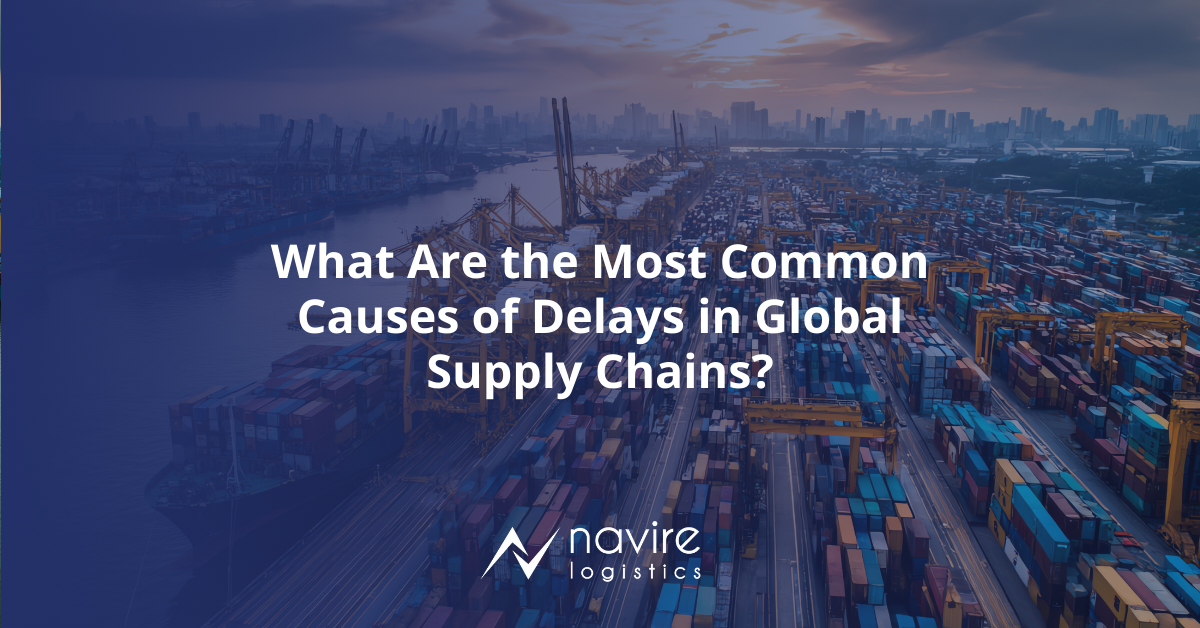
One of the most visible reasons for global Distribution Network delays is port congestion and logistics bottlenecks. Think about thousands of containers stuck at a busy port. Ships cannot unload on time, trucks cannot pick up goods, and warehouses are already overflowing. This one delay creates a chain reaction across countries.
Businesses that depend on fast shipping suddenly find themselves explaining late deliveries to their customers. These causes of delays in global supply chains not only create frustration but also increase costs and reduce efficiency. Every extra day at the port means wasted money and wasted opportunities.
The Climate Change Supply Chain Impact That We Cannot Ignore
Another major factor is the impact of climate change on the Distribution Network. Storms, floods, wildfires, and rising sea levels are not just environmental concerns; they directly contribute to supply chain delays. A storm can shut down airports, a flood can block railroads, and extreme heat can damage storage facilities. These events lead to global distribution Network delays that are difficult to predict.
What makes this issue even more serious is that the climate change Commerce Flow impact is not temporary. It is a long-term challenge, and every year brings stronger weather events. Businesses that ignore this risk will continue to face disruptions that hurt both their Distribution Network and their reputation.
Trade Policy Impact Supply Chain Delays in Unexpected Ways
The trade policy impacts on the Distribution Network problems are often less visible but just as damaging. Rules surrounding tariffs, customs checks, and border controls can change suddenly, leaving businesses at a disadvantage. A shipment ready to cross a border might be delayed for days simply because new paperwork is required. These issues are among the most frustrating causes of Distribution Network delays, as they are completely beyond a company’s control.
In 2025, as many countries update their policies to protect their own industries, the impact of trade policy on supply chain delays is more prevalent than ever. Businesses that fail to prepare for these risks often find themselves trapped in prolonged periods of waiting and escalating costs.
Supply Chain Disruption 2025 And the New Reality of Global Trade
The phrase’ Distribution Network Disruption 2025 ‘captures the new reality. Unlike in the past, where a single problem might cause a delay, today’s disruptions often arise from multiple issues simultaneously. Port congestion and logistics bottlenecks are exacerbated by extreme weather, while political decisions intersect with labor shortages, further complicating the situation.
The result is a web of challenges that creates massive global Commerce Flow delays. The worst part? Businesses cannot always predict where the next disruption will come from. This uncertainty is one of the most significant risks and challenges facing industries in the Commerce Flow today.
If you would like to learn more about seafood supply chain challenges, you can visit our blog for more information.
Human Factors Adding to the Causes of Supply Chain Delays
While we often discuss ports, policies, or climate, the human side also plays a significant role in the causes of delays in the global Distribution Network. Strikes by workers at ports, trucking companies, or warehouses can shut down entire supply routes.
Labor shortages also make it harder to move goods efficiently. Without skilled staff, even advanced systems fail to prevent global Distribution Network delays. These human-driven issues remind us that supply chains are not just about machines and ships; they depend heavily on people, and people bring their own risks.
Technology Gaps, Supply Chain Risks and Challenges
Technology has the power to reduce causes of Distribution Network delays, but many companies still rely on outdated systems. Slow tracking, manual processes, and weak communication create silent global Commerce Flow delays that go unnoticed until it is too late. These are invisible supply chain risks and challenges because businesses often assume everything is fine until shipments fail to arrive.
On the other hand, companies that invest in modern tools can anticipate 2025 supply chain disruption problems before they worsen. Digital tracking, predictive analytics, and AI-driven forecasting all help reduce the climate change impact on the Commerce Flow and manage port congestion and logistics bottlenecks more effectively.
Geopolitics and Causes of Supply Chain Delays
Global trade is deeply affected by politics. Wars, sanctions, and border disputes have always caused delays in international commerce, but in recent years, these risks have multiplied. Geopolitical events often happen suddenly and create instant causes of supply chain delays.
For example, a closed border or a sudden restriction on goods can freeze Distribution Networks in an instant. These political tensions are among the most significant Commerce Flow risks and challenges to prepare for, yet they impact businesses across every industry. In 2025, geopolitical risks pose as significant a threat as natural disasters to disrupting the Distribution Network.
Why are the Causes of Delays in Global Supply Chains Interconnected?
When you put all of this together, it becomes clear that the causes of delays in global Commerce Flow are not separate problems. They are connected. Port congestion and logistics bottlenecks slow down the movement of goods, while the impact of climate change on the Distribution Network makes routes increasingly unpredictable.
The trade policy impacts Commerce Flow rules can change quickly, as the 2025 supply chain disruption demonstrates how multiple challenges overlap. Add in human factors, outdated systems, and geopolitics, and you see why global Distribution Network delays are so challenging to solve. The only way forward is to recognize that these risks don’t exist in isolation; they interact with one another, and collectively, they shape the future of global trade.
Preparing for Supply Chain Risks and Challenges in 2025 and Beyond
The most common causes of delays in global supply chains are not temporary problems. They are part of a new global reality. From port congestion and logistics bottlenecks to the impact of climate change on the Commerce Flow, from the effects of trade policy on distribution networks to the complex supply chain disruptions in 2025, businesses face a world of uncertainty. These supply chain risks and challenges necessitate thoughtful planning, robust partnerships, and innovative solutions to address them effectively. Ignoring them only leads to bigger global supply chain delays and higher costs. However, companies that prepare will not only survive, but they will also succeed.
At Navire Logistics, we believe in helping businesses stay ahead of these challenges. By building flexible strategies, monitoring risks, and adopting more innovative logistics solutions, we ensure your Distribution Network continues to move forward even when the world slows down.
Are you ready to turn Distribution Network risks into opportunities? Reach out to Navire Logistics today and secure your global supply chain for the future.



