
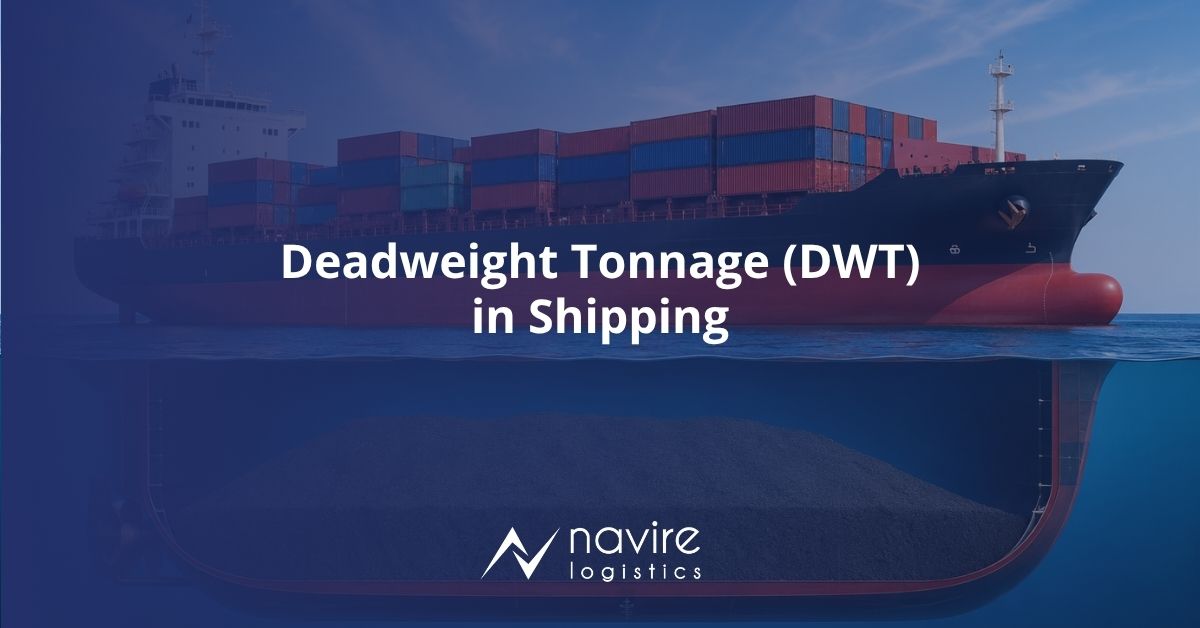
Deadweight tonnage is one of the first specifications shipping professionals check before a vessel is assigned to transport cargo across the world. Yet, surprisingly, many importers, exporters, and even newcomers to logistics have only a vague idea of what deadweight tonnage is and why it plays such a crucial role in maritime operations.
Imagine booking thousands of tonnes of cargo on a vessel that simply cannot carry the required weight. The result could be expensive delays, cargo reallocation, safety risks, and higher freight costs. This is exactly why understanding DWT in shipping is so important. It is much more than a technical number printed on a ship’s specification sheet; it is the measurement that determines how much weight a vessel can safely transport without compromising stability or violating international maritime regulations.
The meaning of deadweight tonnage extends beyond the cargo stored inside a ship’s hold. It includes fuel, ballast water, freshwater, crew, passengers, food supplies, lubricants, and all other operational items that contribute to the ship’s total load. In other words, ship deadweight tonnage reflects the total safe carrying capacity of a vessel throughout its voyage.
Whether you are trying to understand the full form of DWT in shipping, learn how to calculate deadweight tonnage, or simply explore the official definition of deadweight tonnage, this guide will explain every concept in simple terms. You’ll also discover how vessel carrying capacity influences freight planning, operational safety, and shipping efficiency, helping you make more informed logistics decisions.
What Is Deadweight Tonnage? Understanding the Deadweight Tonnage Definition
Every commercial vessel is built with a specific limit that determines the maximum weight it can safely carry. That limit is known as deadweight tonnage or DWT.
In simple terms, deadweight tonnage is the total weight a ship can safely carry when fully loaded. Contrary to what many people assume, this figure is not limited to cargo alone. It includes all additional loads applied to the vessel after it has been built.
The official Load weight is defined as the difference between a ship’s loaded displacement and its lightweight displacement. While this definition may sound technical, the concept is actually straightforward. Think of a ship leaving the shipyard empty. Once fuel, water, food, crew members, equipment, and cargo are loaded on board, the additional weight constitutes the vessel’s deadweight.
This measurement allows ship operators to determine whether a vessel can safely complete a voyage while maintaining proper stability and complying with international maritime regulations.
Understanding what load weight is is essential because exceeding this limit can increase fuel consumption, reduce maneuverability, damage the vessel’s structure, and create serious safety hazards at sea.
DWT Full Form in Shipping and Why It Matters
The full form of DWT in shipping is Deadweight Tonnage.
Although the abbreviation is short, its importance within the shipping industry cannot be overstated. Every charter agreement, cargo booking, and voyage plan considers a vessel’s DWT before confirming shipments.
Shipping companies rely on DWT to determine whether a vessel can accommodate the required cargo while still carrying enough fuel, freshwater, ballast water, crew provisions, and operational equipment for the journey ahead.
Unlike measurements that focus on a ship’s physical size, DWT measures usable carrying capacity. This makes it one of the most practical specifications for freight planners, port authorities, and logistics companies.
For example, two container ships may appear identical in size, but one could have a significantly higher ship Load weight due to differences in design, hull structure, or onboard equipment. Choosing the wrong vessel can lead to inefficient loading, increased costs, or even the need to split cargo between multiple ships.
That is why understanding the full form of DWT in shipping helps businesses optimize freight planning and avoid unnecessary operational challenges.
What Does Deadweight Tonnage Include? Understanding Vessel Carrying Capacity
One of the biggest misconceptions in maritime logistics is that deadweight tonnage refers only to cargo. In reality, the total vessel carrying capacity includes everything that contributes to the ship’s operating weight during a voyage.
These components include:
◾ Cargo
This includes containers, machinery, vehicles, construction materials, agricultural products, minerals, chemicals, and every other type of commercial freight transported by sea.
◾ Fuel
Marine fuel is one of the largest contributors to a ship’s overall weight. Longer voyages require more fuel, reducing the remaining carrying capacity available for cargo.
◾ Freshwater
Every vessel carries freshwater for drinking, cooking, cleaning, and other daily operations. Although it may seem insignificant compared to cargo, its weight is included within the total deadweight.
◾ Ballast Water
Ships use ballast water to maintain stability and balance, particularly when sailing with partial cargo loads. Ballast tanks can hold thousands of tonnes of water depending on the vessel’s size.
◾ Crew, Passengers, and Operational Supplies
Food, safety equipment, lubricants, spare parts, maintenance tools, medical supplies, and the crew themselves all contribute to the vessel’s total operational weight.
When these components are combined, they represent the ship’s total vessel carrying capacity under safe operating conditions.
Understanding this concept helps freight forwarders maximize efficiency while ensuring compliance with international loading regulations.
Why Deadweight Tonnage Is Critical for Modern Shipping
Every cargo shipment begins with one important question:
Can this vessel safely carry the required load?
The answer depends entirely on Load tonnage.
Shipping companies use DWT to select suitable vessels, optimize cargo distribution, estimate freight costs, improve fuel efficiency, and comply with international safety regulations. Without accurate knowledge of a vessel’s carrying capacity, even the most carefully planned shipment can face delays or operational risks.
For logistics providers such as Navire Logistics, understanding ship Load weight is essential for delivering reliable, cost-effective, and safe shipping solutions across international trade routes.
How to Calculate Deadweight Tonnage and Why Every Shipping Company Depends on It
Knowing what deadweight tonnage is is only the first step. The next question most people ask is how to calculate Load weight and why this calculation matters before every voyage.
Although shipping calculations involve sophisticated software and engineering data, the basic principle for calculating load weight is surprisingly simple. Every commercial vessel has two important weight measurements:
◾ Lightweight Displacement
◾ Loaded Displacement
The difference between these two values gives the vessel’s Load tonnage.
✔️ The Formula for Calculating Deadweight Tonnage
The standard formula is:
Deadweight Tonnage (DWT) = Loaded Displacement − Lightweight Displacement
Let’s simplify it with an example.
Imagine a bulk carrier weighs 18,000 tonnes when it is empty. After loading cargo, fuel, ballast water, freshwater, provisions, and the crew, its total weight becomes 63,000 tonnes.
The calculation would be:
63,000 − 18,000 = 45,000 tonnes
In this case, the vessel has a Load weight of 45,000 tonnes.
This means the ship can safely carry a combined total of 45,000 tonnes, including not only cargo but also fuel, water, ballast, crew members, food, and all operational supplies required during the voyage.
This simple calculation forms the foundation of voyage planning for shipping companies worldwide.
Deadweight Tonnage Meaning in Everyday Shipping Operations
The meaning of deadweight tonnage becomes much clearer when viewed from a practical perspective.
Imagine two exporters booking machinery for shipment.
Both choose vessels that appear almost identical in length and width. However, one ship has a ship Load weight of 28,000 tonnes, while the other has 45,000 tonnes.
Although they look similar, the second vessel can transport considerably more cargo while still carrying enough fuel and operational supplies.
This difference affects almost every stage of logistics planning, including:
◾ Cargo booking
◾ Freight pricing
◾ Route selection
◾ Fuel planning
◾ Loading schedules
◾ Port operations
◾ Safety compliance
Without understanding the meaning of deadweight tonnage, businesses may underestimate a vessel’s capabilities or, even worse, overload it.
That is why shipping professionals evaluate DWT before confirming almost every international shipment.
Deadweight Tonnage vs Gross Tonnage vs Net Tonnage
One of the most common misunderstandings in maritime logistics is confusing deadweight tonnage with Gross weight or Net Tonnage.
Although these measurements all include the word “tonnage,” they describe completely different characteristics of a vessel.
✔️ Deadweight Tonnage
Deadweight tonnage measures the maximum safe weight a vessel can carry.
It includes:
◾ Cargo
◾ Fuel
◾ Ballast water
◾ Freshwater
◾ Crew
◾ Passengers
◾ Food
◾ Spare parts
◾ Operational supplies
This is the figure logistics companies use when evaluating vessel carrying capacity.
✔️ Gross Tonnage
Gross Tonnage measures the ship’s internal enclosed volume rather than its weight.
It is mainly used for:
◾ Port charges
◾ Ship registration
◾ International regulations
◾ Safety certifications
A larger Gross Tonnage does not automatically mean a ship can transport more cargo.
✔️ Net Tonnage
Net Tonnage represents the volume available for commercial cargo.
It excludes engine rooms, crew accommodation, navigation spaces, and machinery compartments.
While Net weight helps estimate cargo space, it does not determine how much weight the vessel can safely carry.
For cargo planners, Load tonnage remains the most valuable measurement because shipping decisions depend on safe weight limits rather than internal volume alone.
Factors That Influence Ship Deadweight Tonnage During a Voyage
Although every vessel has a certified ship deadweight tonnage, the available cargo capacity varies across voyages.
Several operational factors influence how much cargo can actually be loaded.
✔️ Fuel Requirements
Long-distance voyages require significantly more fuel.
Since fuel contributes to the ship’s total deadweight, carrying additional fuel reduces the remaining cargo capacity.
For example, a vessel traveling from Asia to Europe requires considerably more fuel than one operating within the Middle East.
✔️ Ballast Water
Ballast water keeps ships balanced and stable, especially when cargo loads are uneven.
Large quantities of ballast water occupy part of the available vessel carrying capacity, reducing the maximum cargo weight that can be transported safely.
✔️ Weather Conditions
Severe weather often requires ship operators to reduce cargo loads to improve stability.
During rough sea conditions, maintaining a safety margin becomes more important than maximizing cargo weight.
✔️ Water Density
Ships float differently in freshwater and seawater.
Because seawater provides greater buoyancy, vessels may safely carry slightly more weight than they can in freshwater.
This is one reason why international load line regulations specify different loading limits for different water conditions.
✔️ International Maritime Regulations
Every commercial vessel must comply with international safety standards regarding loading limits.
Classification societies and maritime authorities regularly inspect vessels to ensure they remain within their approved Load tonnage limits.
Ignoring these regulations can lead to heavy fines, shipment delays, detention, or serious safety risks.
How Deadweight Tonnage Affects Freight Planning and Shipping Costs
When customers request freight quotations, they often focus on destination, transit time, and shipping rates.
Behind the scenes, however, logistics professionals are evaluating something much more important: load tonnage.
The available vessel carrying capacity determines:
◾ Whether all cargo can travel on one vessel
◾ Whether multiple vessels are required
◾ Fuel consumption estimates
◾ Cargo loading plans
◾ Port handling schedules
◾ Overall shipping costs
Choosing a vessel with insufficient DWT may require splitting cargo into multiple shipments, increasing handling costs and extending delivery timelines.
Conversely, selecting a vessel with an appropriate ship Load tonnage allows cargo to be transported more efficiently while maximizing operational performance.
For freight forwarders, understanding DWT in shipping helps improve planning accuracy, minimize delays, and optimize transportation costs for customers.
Deadweight tonnage as the most fundamental concept
Deadweight tonnage is one of the most fundamental concepts in maritime logistics. It defines the maximum weight a vessel can safely carry, including cargo, fuel, freshwater, ballast water, crew, passengers, and operational supplies.
Understanding the full form of DWT in shipping, the definition of Load tonnage, and how to calculate Load tonnage enables businesses to choose suitable vessels, improve cargo planning, enhance safety, and optimize shipping costs.
Whether you’re managing international freight, comparing vessels, or simply learning about maritime transport, Load tonnage provides valuable insight into a ship’s true vessel carrying capacity.
As global trade continues to grow, a clear understanding of DWT will remain essential for safe, efficient, and cost-effective shipping operations.



